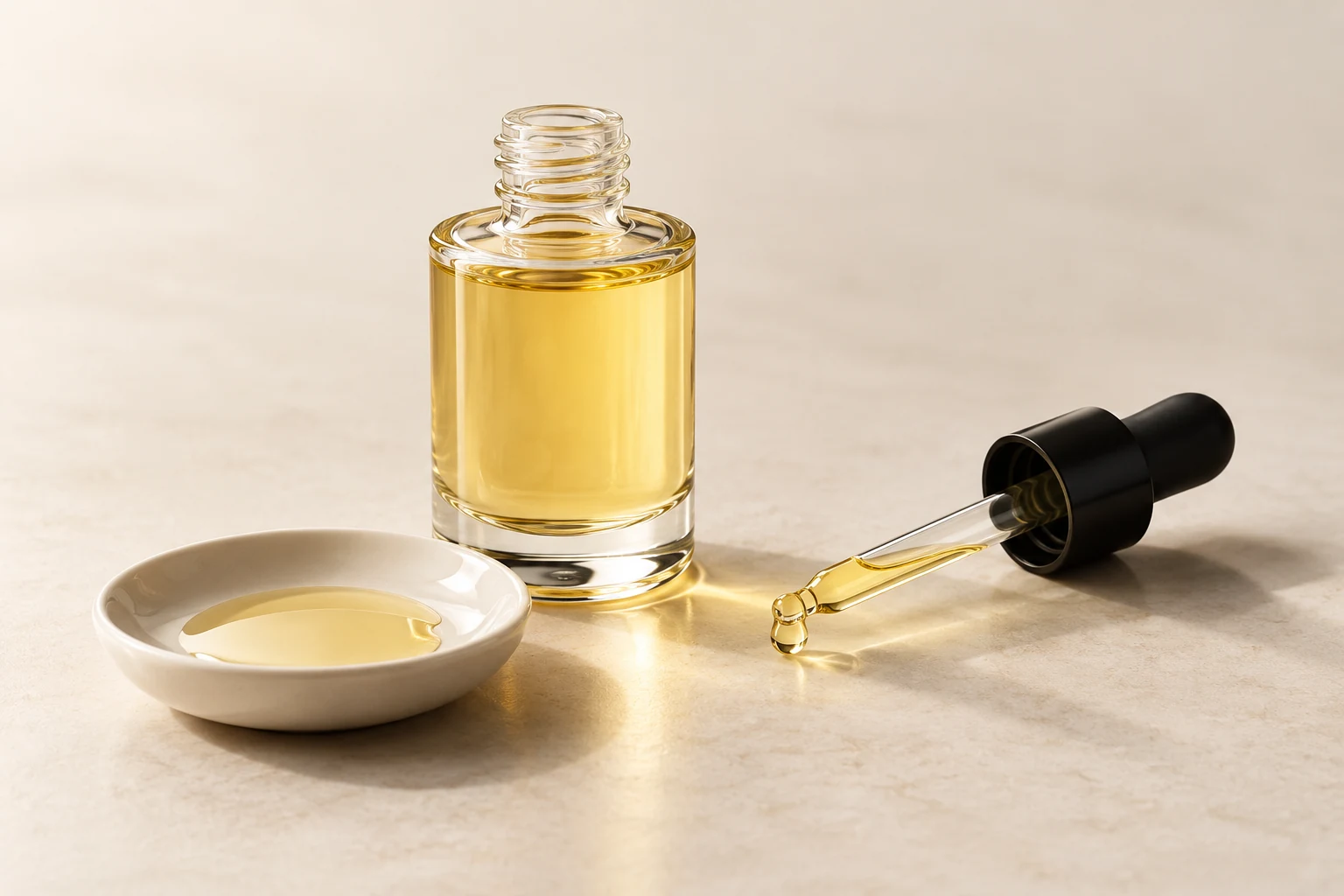
A waterless peptide oil serum needs a peptide grade that can be incorporated into the proposed oil system and remain suitably distributed throughout its use. Adding a familiar water-based peptide stock to facial oil changes the composition of the product. Start with the commercial grade's full composition and compatibility evidence, then decide whether the brief calls for an oil solution, a dispersion or a different format.
Define what the finished product is meant to be
Write the physical format into the brief: a clear single-phase oil, a deliberately dispersed system or a product with separate phases. These formats need different specifications and use directions. A cloudy prototype is not automatically a failed clear serum if the approved concept is a controlled dispersion, but its uniformity and dose still need evaluation.
Ask whether the supplier describes the peptide grade as soluble, dispersible or supplied in a delivery carrier. These terms are not interchangeable. An INCI prefix such as palmitoyl does not, by itself, demonstrate that the complete commercial ingredient will dissolve in the selected oil blend at the intended addition level.
Croda's published overview describes lipid-based delivery systems for cosmetic peptides. It supports considering a suitable carrier system during development; it does not provide a universal mixing instruction or establish compatibility with an arbitrary oil formula. [1]
Calculate water carried in by stock solutions
A hypothetical peptide stock contains 80% water by weight and is added at 2.00% of the finished batch. It contributes:
This calculation assumes those stated mass fractions and no other water inputs. The finished composition cannot be described as containing zero water on that basis. The remaining ingredients in the stock also enter the formula and should be included in the bill of materials and label review.
Count the whole commercial blend
Request quantitative or suitably bounded information on water and carrier content. Record the nominal active content separately from the trade-ingredient addition level. If confidential composition prevents the brand from doing the calculation, arrange review by the formulator or safety assessor under appropriate confidentiality terms.
The stock solution versus raw powder guide provides related procurement questions. Switching to powder may remove a liquid carrier, but it does not establish oil solubility.
Look for consistent composition in the dispensed dose
Appearance alone cannot demonstrate that peptide content remains uniform. A dispersion can settle, while a clear sample can change during storage. The development plan should consider the initial product, aged samples and material delivered by the intended package.
- Check the proposed grade in the actual oil blend at the intended use level.
- Define acceptable appearance and any allowable settling before the trial starts.
- Evaluate distribution with an appropriate, qualified analytical approach where peptide uniformity is critical.
- Review the first, middle and later dispensed portions under the intended use conditions.
- If shaking is required, verify that the stated instruction produces the expected distribution and is practical for users.
Do not publish a shake-before-use instruction merely to excuse an uncontrolled unstable prototype. The package and directions must be part of the qualification.
Assess microbial risk for the actual product
ISO 29621:2017 provides a framework for identifying microbiologically low-risk finished cosmetics through risk assessment. Its scope includes production and intended use. The word anhydrous on a brief is not a completed assessment. [2]
Ask the safety and microbiology specialists to consider the actual composition, water activity where relevant, manufacturing controls, packaging and foreseeable consumer handling. An oil product used with damp hands or a repeatedly opened applicator has a different exposure scenario from an untouched development sample. Decide the appropriate evidence and testing from that assessment rather than borrowing the preservative position of another product.
FDA identifies inadequate packaging, contaminated raw materials or water, manufacturing conditions and consumer use among routes of cosmetic microbial contamination. This is why the finished package belongs in the review. [3]
Qualify the oil base and package together
Track odour, colour, physical state and package function under the agreed stability programme. Include the actual bottle, closure and dropper or pump. Check whether the components contact the formula during storage and whether repeated dispensing changes the delivered amount or leaves material behind.
FDA notes that air, sunlight and temperature changes can alter cosmetic colour, texture and odour. Removing added water does not remove these shelf-life questions. [4] Set acceptance criteria for the product you intend to sell, and distinguish observed test results from a proposed shelf life that still needs support.
Choose the format after the feasibility review
Keep the oil-serum concept if a documented grade meets the brief and the finished product passes its agreed assessments. If the preferred peptide arrives in an incompatible aqueous stock, revisit the format or the grade. A conventional emulsion or a separately qualified multi-part package may be a better fit, but either choice creates a new development and evidence package.
Send an OEM enquiry with the target texture, peptide identity, proposed claim, market and packaging concept. Ask for a feasibility assessment and a sample plan before requesting a production quotation.
Frequently asked questions
Can I add a water-based peptide stock to a facial oil and call it waterless?
Calculate the water and other components contributed by the stock. A water-containing input changes the composition; the resulting physical system and claim need review.
Are palmitoylated peptides always oil soluble?
The name alone does not demonstrate solubility of a particular commercial grade in a chosen oil blend. Obtain grade-specific information and verify the proposed formula.
Does an anhydrous peptide serum automatically need no preservation assessment?
No. Assess the actual product, manufacturing controls, package and intended use. The appropriate microbiological evidence follows that risk assessment.
Can the serum be released if it looks clear and has no sediment?
Those observations are useful but do not establish peptide content, distribution, shelf life or safety. Release should follow the agreed finished-product specification and evidence package.
Sources and scope
Sources checked on 31 October 2026. This is editorial guidance for cosmetic formulation and procurement. Examples are hypothetical unless a source is identified; no original product testing or certification is claimed.
- Croda Beauty: Cosmetic peptides and delivery systems
- ISO 29621:2017: Microbiologically low-risk cosmetics
- FDA: Microbiological Safety and Cosmetics
- FDA: Shelf Life and Expiration Dating of Cosmetics
Regulatory points are market-specific. Confirm the applicable requirements and product assessment before launch. For a correction or a question about the sources, contact Pure Peptide Serum.